Perceived Stress Scale (PSS-10): What It Is, How It Works, and What Your Score Means
The Perceived Stress Scale (PSS) is one of the most widely used and researched tools for understanding how stressed a person feels in their day-to-day life. Unlike measures that look only at specific events or diagnoses, the perceived stress scale focuses on how unpredictable, uncontrollable, and overwhelming life feels right now. That perspective matters, because the way we experience stress often shapes our sleep, energy, focus, and long-term health more than any single stressful event.
This guide breaks down how the PSS-10 works, how to interpret your stress score, how to track changes over time, and how to use a simple online tool to quantify your stress in minutes. You’ll also find answers to common questions about reliability, accuracy, and next steps.
What Is the Perceived Stress Scale?
The perceived stress scale is a short, science-backed questionnaire designed to capture your subjective experience of stress over the past month. The most common version is the 10-item PSS-10. You respond to each item on a 0–4 scale (from “never” to “very often”), and a total score is calculated. Unlike clinical screenings for anxiety or depression, the PSS is not a diagnosis—it’s a practical, validated way to monitor how stressed you feel and to guide stress management decisions.
Why Measuring Perceived Stress Matters
- It captures your lived experience: You might be handling a heavy workload well, or you might feel overwhelmed by relatively small changes. The PSS focuses on how you feel, which is what often drives health and behavior.
- It’s linked to health outcomes: Higher perceived stress is associated with sleep problems, digestive issues, headaches, reduced concentration, and greater risk of burnout over time.
- It guides action: Tracking your score helps you evaluate whether lifestyle changes, therapy, mindfulness, movement, or time off are working.
How the PSS-10 Is Scored
The PSS-10 has 10 items, each scored from 0 to 4. Four of the items are positively worded (for example, feeling confident in handling personal problems) and are reverse-scored to ensure the total reflects perceived stress rather than optimism. The total score ranges from 0 to 40.
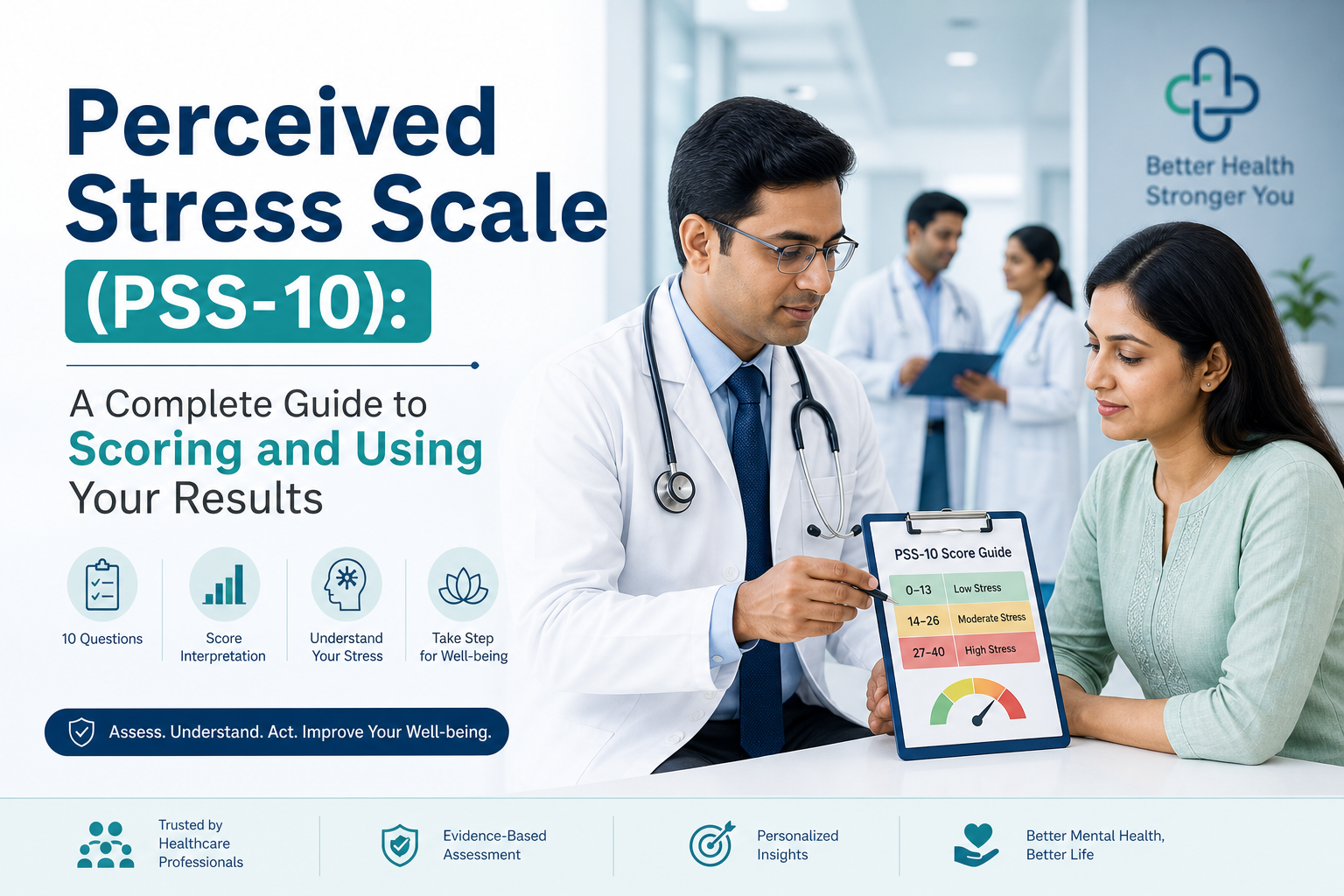
Though there is no single universal cutoff, many studies and clinical references use the following guide:
- Low stress: 0–13
- Moderate stress: 14–26
- High stress: 27–40
Your stress score should be interpreted in context—consider your recent life events, baseline stress tolerance, and any physical or mental health conditions. A one-time high score isn’t a diagnosis, but it can be a meaningful signal to pause, reflect, and plan next steps.
Take the PSS-10 in Minutes
Want a fast, reliable way to calculate your PSS-10 score and see where you stand? Try this simple stress calculator. It walks you through the PSS-10 questions, totals your score, and helps you understand what the result means for your day-to-day well-being. If you prefer to self-administer the official form, the format is identical: 10 questions, each answered on a 0–4 scale, with a total out of 40.
Who Should Use the PSS-10?
The PSS-10 is suitable for most adults and older adolescents. It’s frequently used in research, clinical settings, and workplace wellness programs as a quick stress assessment and ongoing tracking tool. It’s particularly useful if you’re:
- Noticing new sleep, concentration, or mood changes
- Going through a transition at work or home
- Managing chronic conditions that flare with stress
- Monitoring the impact of therapy, coaching, or self-care practices
How Often Should You Recheck Your Score?
For most people, repeating the PSS-10 every 2–4 weeks is enough to see meaningful trends. More frequent checks (weekly) can be helpful during particularly intense periods or while starting new routines (e.g., exercise or mindfulness). If your score is consistently high (27–40) or rising over several checks, consider connecting with a licensed clinician for tailored support.
Interpreting Your Results (and What to Do Next)
Here’s a practical way to use your PSS-10 score:
- Low (0–13): You may be handling current demands well. Protect what’s working—sleep, movement, social connection—and plan for upcoming stressors.
- Moderate (14–26): This range is common. Identify top stress drivers and choose one or two realistic adjustments (e.g., time blocking, boundaries on notifications, 10 minutes of daily mindfulness, or a short walk after meals).
- High (27–40): Your stress feels heavy and frequent. Consider stepping back from non-essential tasks, asking for help at work or home, and scheduling time with a mental health professional. If you’re experiencing panic, thoughts of self-harm, or inability to function in daily life, seek urgent help now.
PSS-10 vs. Other Versions
The original scale has 14 items (PSS-14), and there is a brief 4-item version (PSS-4). The 10-item version balances accuracy with speed and is the most commonly used in research. If you want to complete the PSS-10 online quickly and see your results instantly, digital formats are ideal.
Is the PSS a Diagnosis?
No. The PSS is a validated mental health tool for gauging perceived stress, not a diagnostic test for anxiety, depression, PTSD, or other conditions. Think of it as a dashboard indicator: it signals how overwhelmed you feel and helps you decide whether to add stress management strategies or consult a professional.
How Reliable Is the PSS-10?
The PSS-10 is one of the most studied stress measures. It shows strong internal consistency and good correlations with related constructs (like anxiety and negative affect), while remaining distinct from them. It’s been translated and validated across languages and cultures. That said, results can vary day to day with sleep, illness, hormones, or major events. This is why repeated tracking over time often tells the most useful story.
Using the PSS-10 to Drive Real Change
Your score is a starting point. Here’s how to make it actionable:
- Identify your top 1–2 stressors: Workload? Caregiving? Finances? Ambiguity? Choose small levers with outsized impact.
- Pair stressors with specific actions: For nonstop notifications, set 2–3 check-in windows. For rumination, try a 10-minute mindfulness practice or journaling prompt at the same time each day.
- Protect recovery: Prioritize sleep consistency, a short daily walk, and ten minutes of quiet. Recovery is the foundation of resilience.
- Enlist support: Share your results with a partner, manager, coach, or clinician. External accountability often turns intentions into habits.
- Recheck and reflect: Use a repeating stress level test cadence (e.g., every two weeks) and note what helped or hurt since your last score.
Measure Your Stress Online—Free and Fast
If you prefer a quick digital experience, you can measure stress online using a streamlined PSS-10 format. You’ll get an immediate total along with a plain-language explanation of low, moderate, or high stress and links to helpful resources. Because it’s a free stress test, you can retake it regularly to see trends without any barrier.
Step-by-Step: Taking the PSS Test
- Choose a calm moment with minimal distractions.
- Think about the last month. Answer each item honestly based on how often you felt or thought that way.
- Let the calculator total your score and classify it into low, moderate, or high stress.
- Write down one observation about what may be driving your score and one realistic action to try this week.
- Set a reminder to retake the PSS test in two weeks and compare results.
When to Seek Professional Help
If high stress persists or interferes with work, relationships, or basic self-care, consider talking with a licensed mental health professional. Immediate help is recommended for panic that doesn’t subside, inability to function, or any thoughts of harming yourself or others. The PSS can guide that decision, but it doesn’t replace professional judgment.
FAQ: Perceived Stress Scale (PSS-10)
What does the PSS-10 actually measure?
It measures how unpredictable, uncontrollable, and overloaded your life feels right now. It’s about your subjective stress experience over the past month, not objective events or a medical diagnosis.
Is there a ‘good’ or ‘bad’ score?
Lower scores generally indicate feeling less stressed, but context matters. A moderate score is common, and a high score can be a helpful signal to pause, seek support, and add stress management strategies.
Can I use the PSS-10 for workplace or program evaluation?
Yes. Many wellness and coaching programs track the PSS-10 at baseline and at regular intervals to measure change. It serves as a simple, scalable metric of perceived stress over time.
What’s the difference between the PSS-10 and PSS-14?
The PSS-14 has 14 items and was the original format. The PSS-10 is shorter and widely validated, offering a strong balance of precision and speed. Very brief programs sometimes use the four-item version (PSS-4), but it’s less precise.
Is the PSS-10 appropriate for teenagers?
It’s often used with older adolescents, though interpretation should consider developmental context and be reviewed with a clinician if stress is high or persistent.
How do I use my score to improve stress management?
Focus on one or two small, repeatable habits: consistent bedtime, daily movement, scheduled digital breaks, and brief relaxation or breathing exercises. Track your PSS every 2–4 weeks to see what helps most.
Can I take the PSS-10 online?
Yes—many people prefer a digital format to save time and automate scoring. You can complete the PSS-10 online and get immediate feedback, then retake it periodically to monitor progress.
Put Your Score to Work Today
The perceived stress scale is a practical compass: it tells you where you are now so you can decide where to go next. Whether your score is low, moderate, or high, the most effective plan is simple, specific, and sustainable. Start with one change, track your results, and adjust. Over a few weeks, small wins compound.
If you’re ready to quantify your stress and turn insight into action, try the quick online assessment now. It’s a straightforward way to take stock, create a plan, and stay accountable to yourself.
measure stress online in minutes with a research-backed tool, or retake a free stress test regularly to watch your trendline improve over time.
Take the Free Stress Calculator Test Now
Remember: Your score is information, not a judgment. Use it to guide care—sleep, movement, nourishment, connection—and to reach out for professional support when you need it. That’s what effective stress management looks like in real life.